By Alison Fortune.
Stephen King was so prolific, so non-stop, that early in his career he created a pseudonym to offload some of his work onto because his publisher told him they could not release his books at the rate he was writing them. That pseudonym was named Richard Bachman, and King used him as a venue to release his darker work. Two Bachman novels, The Long Walk and The Running Man, have both been adapted into films releasing this year; although the aesthetics and tones of both films sharply differentiate them, their premises are notably similar.
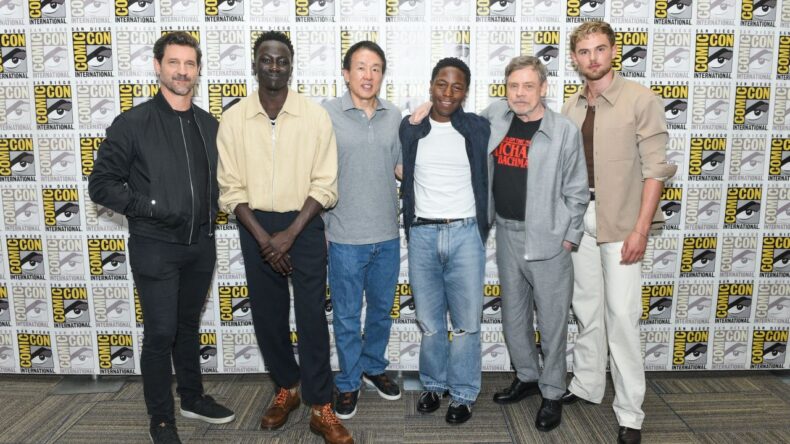
I attended the panel SDCC hosted in anticipation of The Long Walk, which included a preview into the first 20 minutes of the film. We see how fifty boys, one volunteer from each state, must embark on a walk. The last boy standing receives both an enormous amount of wealth and the granting of any wish of his choosing. Although the language used by the officers supervising them is deliberately ambiguous, the actions of the film make the stakes clear: if you falter or stop, you die, shot down by the armed guard accompanying the walk. The sneak peak shown in the panel was edited as to remain appropriate for the all ages room; however, the cut from the muzzle of a machine gun next to a boy’s head straight to a black screen, punctuated by the crack of the gun, makes it all too clear what occurs.
Although The Running Man did not have a panel at SDCC, its trailer is currently available. The film also features a dystopian contest; however, instead of fifty boys competing against each other, it involves one man competing against the whole world. The main character, played by Glen Powell, must evade being located for one month while his scramble for freedom is being shown live as a reality television show. If the man succeeds, he will be rewarded with a magnificent cash prize. If he is caught, he is killed, and his death is broadcast on live television for the world to revel in.
The mood of The Long Walk is dreary, slow, and dingy, whereas The Running Man pops with bright colors, futuristic technology, and fast-paced sequences. However, I think it is very telling that two films this year feature struggles for survival and financial security in dystopian worlds, struggles that are fodder for entertainment. Every day, we are inundated with reality shows that offer monetary gain for the participants’ willingness to engage in what seem to be little more than public humiliation rituals. The Traitors. Survivor. Love Island. All of these shows involve real humans competing against each other, tearing each other down and scheming against each other, to emerge victorious and financially secure. Every aspect of our modern lives is liable to be commodified and broadcast for the entertainment of the masses. Although both of these films take that concept to its absolute extreme, what they depict is only shades away from what we are already living.


The Pitt

Season 2 of Percy Jackson and the Olympians

Lorde Concert Review SDCC

Percy Jackson and the Olympians Reveals Season 2

Our Flag Means Death: A Hilarious and Heartwarming NYCC 2023 Panel Review